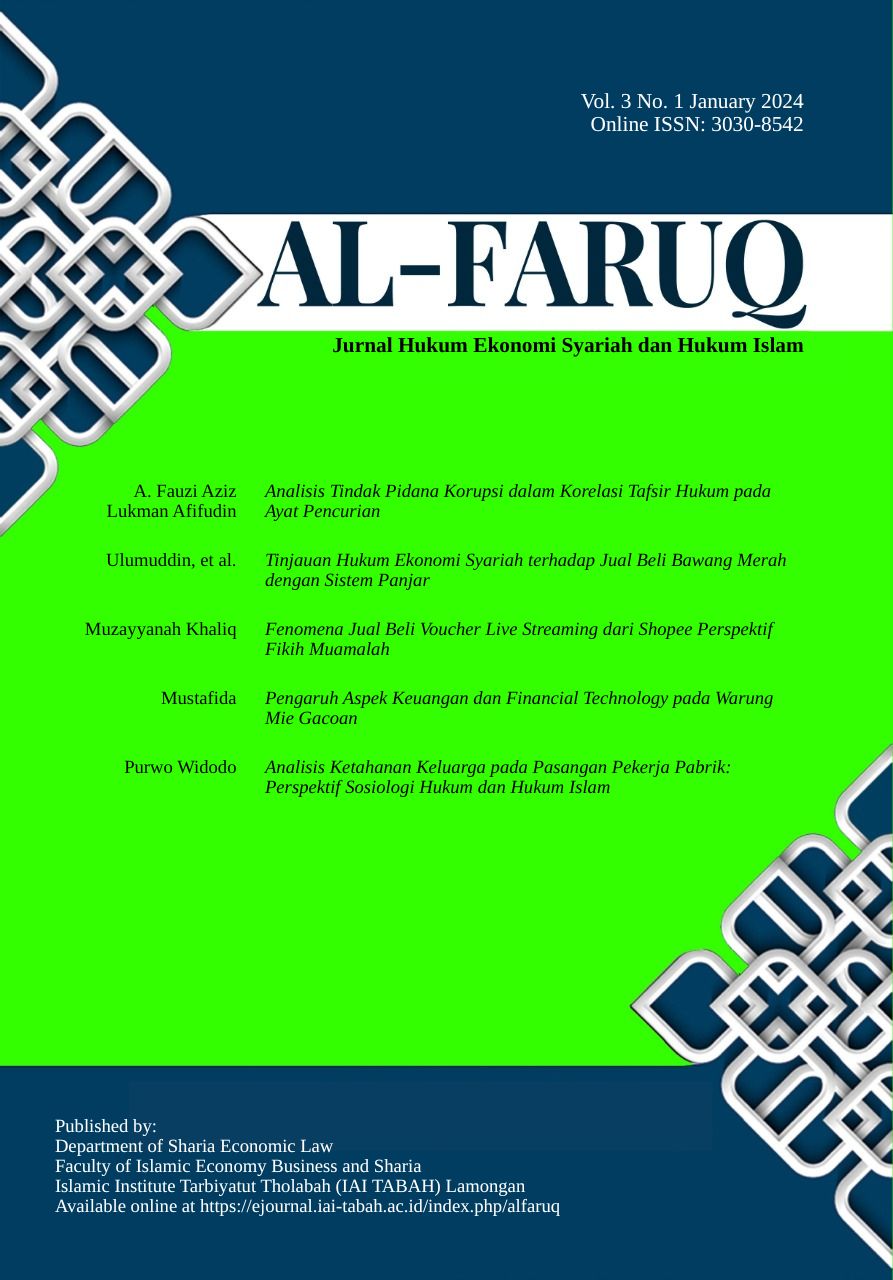
Analisis Tindak Pidana Korupsi dalam Korelasi Tafsir Hukum pada Ayat Pencurian
DOI:
https://doi.org/10.58518/al-faruq.v3i1.2343Keywords:
Legal interpretation, Theft verses, Corruption, Classical ulama, Contemporary ulamaAbstract
Legal interpretation aims to comprehend and apply the law contained within verses of the Quran. One such verse, Surah Al-Maidah, Ayah 38, discusses theft-related punishment. This verse has been interpreted by various scholars, both classical and contemporary, from diverse perspectives and methodologies. This study aims to analyze and compare the interpretations of the law on theft-related verses in correlation with corruption, a criminal act that damages the state's finances. The research adopts a qualitative method using a literature review approach. The data used consists of tafsir books, articles, journals, and relevant legal documents. The findings reveal differences and similarities between classical and contemporary scholars in interpreting the law on theft. Classical ulama tend to adhere to a literal and textual understanding of the verse, prescribing the punishment of cutting off the hand without differentiating the type or value of the stolen item. Contemporary ulama tend to utilize contextual and rational approaches, allowing theft punishments to vary based on societal conditions and situations. Concerning corruption, some contemporary ulama consider it within the theft category, thus advocating punishments such as hand amputation or equivalent penalties. Other contemporary ulama argue that corruption does not fall under theft, hence its punishment should align with prevailing positive law provisions. Furthermore, the correlation between Surah Al-Maidah, Ayah 38, and corruption lies in aspects like: (1) illegal acquisition of wealth, (2) detrimental effects on society and (3) detrimental effects on state.
References
Amin, Ach. Wasila. “Tindak Pidana Korupsi Pengadaan Alat Kesehatan Yang Dilakukan Oleh Mantan Gubernur Banten Ditinjau Dari Aspek Hukum Pidana Positif Dan Hukum Pidana Islam (Analisis Putusan Nomor: 040/PID.SUS/TPK/2017/PN.JKT.PST).” Universitas Islam Negeri Syarif Hidayatullah Jakarta, 2019. http://repository.uinjkt.ac.id/dspace/handle/123456789/47270.
Dzulkifli. “Kebijakan Hukum Pidana Terhadap Penetapan Penangguhan Penahanan Dalam Perkara Tindak Pidana Korupsi.” Universitas Jambi, 2023. https://repository.unja.ac.id/id/eprint/49805.
Firdausi, Liza. “Korupsi Dalam Al-Qur’an (Studi Komparatif Tafsir Ibnu Katsir Dan Tafsir Al-Azhar Terhadap Ayat-Ayat Tentang Korupsi).” Universitas Islam Negeri KH Achmad Siddiq Jember, 2021. http://digilib.uinkhas.ac.id/id/eprint/12371.
Friski, Muhammad Lioni. “Putusan Bebas Pada Kasasi Dalam Perkara Tindak Pidana Korupsi Bantuan Likuiditas Bank Indonesia (Analisis Putusan Kasasi Mahkamah Agung Nomor: 1555 K/Pid.Sus/2019).” Universitas Islam Negeri Syarif Hidayatullah Jakarta, 2021. https://repository.uinjkt.ac.id/dspace/handle/123456789/57120.
Listawati. “Pertanggungjawaban Pidana Korporasi Pada Perkara Tindak Pidana Pencucian Uang.” Justitia et Pax 37, no. 2 (2021): 251–266.
Margono. “Rekonstruksi Regulasi Peradilan Pidana Terhadap Tindak Pidana Korupsi Untuk Mewujudkan Penegakan Hukum Yang Berkeadilan.” Universitas Islam Sultan Agung Semarang, 2022.
Mutammimah, Bidayatul. “Rekonstruksi Konsep Dalil Qath’i Perspektif Abu Ishaq Al-Syathibi Dalam UU Tipikor Pasal 2 Ayat (1).” Universitas Islam Negeri Syarif Hidayatullah Jakarta, 2022. https://repository.uinjkt.ac.id/dspace/handle/123456789/61751.
Rafiqi, Ilham Dwi. “Tafsir Wewenang Seponering Jaksa Agung Pasca Putusan Mahkamah Konstitusi Nomor 29/PUU-XIV/2016.” Widya Yuridika 4, no. 2 (2021): 307–322.
Ragani, Muhammad Azriel Raditya. “Peranan Intelijen Kejaksaan Dalam Pengungkapan Dugaan Tindak Pidana Korupsi ( Studi Kasus Kejaksaan Tinggi Jawa Tengah ).” Universitas Islam Sultan Agung Semarang, 2022.
Rahim, Arhjayati, and Madinah Mokobombang. “Analisis Penerapan Pembuktian Terbalik Dalam Kasus Tindak Pidana Korupsi.” Al-Mizan 16, no. 2 (2020): 225–248.
Rahman, Muhammad. “Nilai-Nilai Politik Dalam Al-Qur’an Dan Implementasinya (Studi Analisis Tafsir Maqashidi).” Institut Ilmu Al-Qur’an Jakarta, 2023. http://repository.iiq.ac.id//handle/123456789/2503.
Rauf, Moh. Abd. “Rancangan Formulasi Perluasan Penerapan Hukuman Mati Dalam Undang-Undang Tindak Pidana Korupsi.” Universitas Islam Negeri KH Achmad Siddiq Jember, 2020. http://digilib.uinkhas.ac.id/id/eprint/11809.
Rizki, Qadar. “Korupsi Menurut Perspektif Ibn ‘Asyur (Studi Analisis Tematis Dalam Tafsir Al-Tahrir Wa Al-Tanwir).” Institut Ilmu Al-Qur’an Jakart, 2022. http://repository.iiq.ac.id//handle/123456789/1962.
Rohmah, Miftahur, and M. Riyan Hidayat. “Hukuman Koruptor Perspektif TM Hasbi Ash-Shiddieqy:(Studi Analisis Dalam Tafsir Al-Qur’anul Majid An-Nur QS. Al-Maidah [5]: 38-40).” Pappasang 3, no. 2 (2021): 85–102.
Sutoyo, Daniel. “Tinjauan Teologis Terhadap Wacana Penerapan Hukuman Mati Bagi Pelaku Tindak Pidana Korupsi Di Indonesia.” DUNAMIS: Jurnal Teologi dan Pendidikan Kristiani 3, no. 2 (2019): 171–198.
Umam, Hafid Khoirul. “Pertanggungjawaban Hukum Bagi Notaris Yang Terlibat Dalam Tindak Pidana Korupsi Pengadaan Tanah Badan Urusan Logistik (Studi Kasus Putusan Nomor 90/Pid.Sus-Tpk/2022/Pn Smg).” Universitas Islam Sultan Agung Semarang, 2023.
Downloads
Published
Issue
Section
License
Copyright (c) 2024 Al-Faruq: Jurnal Hukum Ekonomi Syariah dan Hukum Islam

This work is licensed under a Creative Commons Attribution-ShareAlike 4.0 International License.
Authors who publish with this journal agree to the following terms:
- Copyright on any article is retained by the author(s).
- The author grants the journal, right of first publication with the work simultaneously licensed under a Creative Commons Attribution License that allows others to share the work with an acknowledgment of the work’s authorship and initial publication in this journal.
- Authors are able to enter into separate, additional contractual arrangements for the non-exclusive distribution of the journal’s published version of the work (e.g., post it to an institutional repository or publish it in a book), with an acknowledgment of its initial publication in this journal.
- Authors are permitted and encouraged to post their work online (e.g., in institutional repositories or on their website) prior to and during the submission process, as it can lead to productive exchanges, as well as earlier and greater citation of published work.
- The article and any associated published material is distributed under the Creative Commons Attribution-ShareAlike 4.0 International License