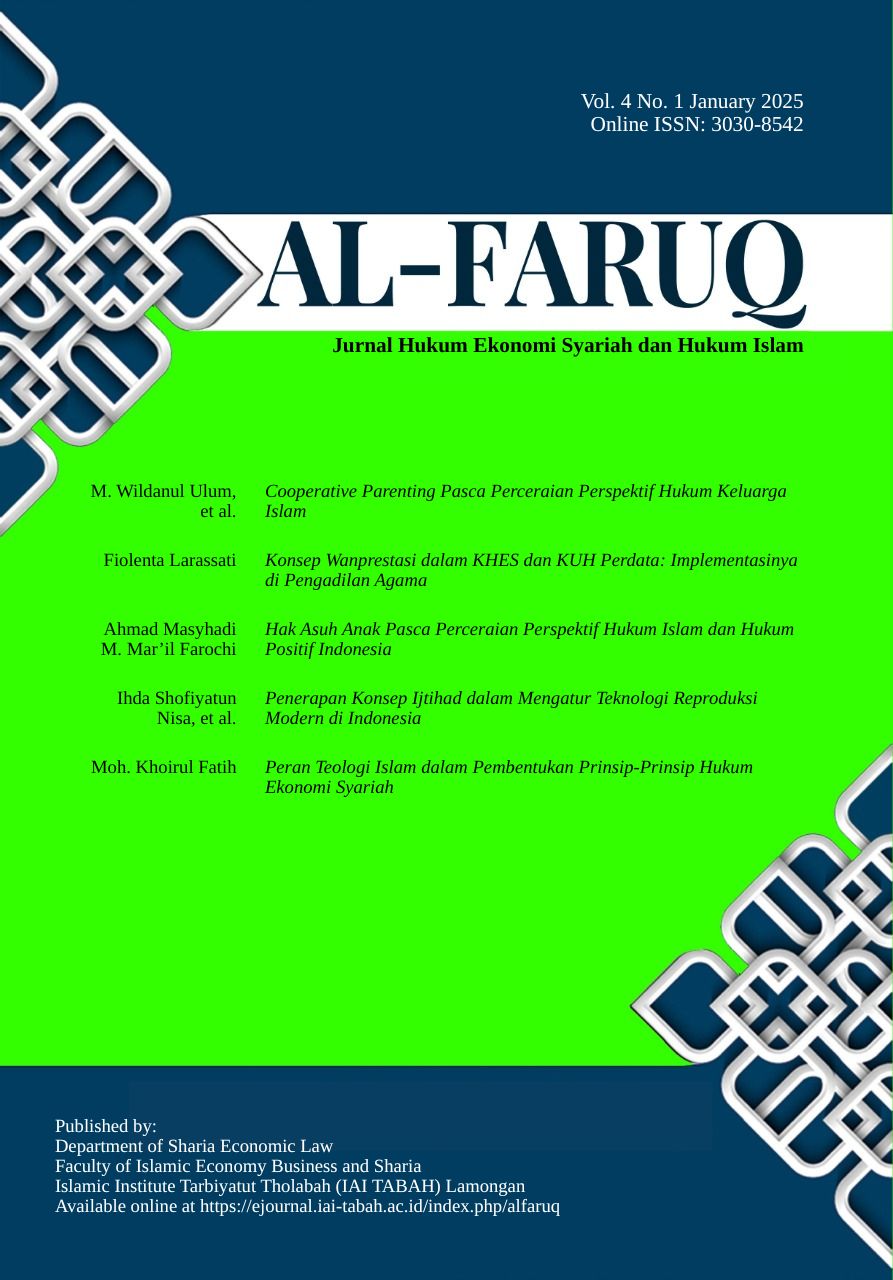
Konsep Wanprestasi dalam KHES dan KUH Perdata: Implementasinya di Pengadilan Agama
DOI:
https://doi.org/10.58518/al-faruq.v4i1.3380Keywords:
Breach of Contract, Compilation of Sharia Economic Law, Civil Code, Religious Court, Sharia EconomicsAbstract
The rapid growth of the sharia economy in Indonesia has raised challenges in resolving disputes in this field, especially related to breach of contract. Although the Compilation of Sharia Economic Law (KHES) has been established as a legal guideline for Religious Courts, judicial practice still often refers to the Civil Code (KUH Perdata), which is rooted in Western legal traditions. This study aims to analyze the breach of contract concept in the KHES and the Civil Code and its implementation in the decisions of the Religious Court. The method used is a juridical-normative approach with a deductive analysis of court decisions and related regulations. The results of the study show that there are inconsistencies in the implementation of KHES, which can have an impact on legal uncertainty. The implications of these findings emphasize the need to strengthen regulations and increase judge’s capacity to implement KHES to ensure legal certainty and justice in resolving sharia economic disputes.
References
Ahmad Saeful and Sulastri “Riba dan Bunga Bank Dalam Perspektif Islam”, Madani Syari’ah, Vol. 4, No. 1, 2021.
Ah. Azharudin Latif dan Nahrowi, Pengantar Hukum Bisnis Pendekatan Hukum Positif & Hukum Islam, Jakarta: Lembaga Penelitian UIN Jakarta, 2009, Cet. Pertama.
Asikin, Zainal, Pengantar Tata Hukum Indonesia, Jakarta: PT RajaGrafindo Persada, 2016, Cet. Ketiga.
Atikah, Ika, “Eksistensi Kompilasi Hukum Ekonomi Syariah (KHES) Sebagai Pedoman Hakim Dalam Menyelesaikan Perkara Ekonomi Syariah Di Pengadilan Agama”, Jurnal Hukum Ekonomi Syariah, Vol. 9, No. 2, 2017.
DataIndonesia.id diakses dari https://dataindonesia.id/ragam/detail/populasi-muslim- indonesia-terbesar-di-dunia-pada-2022 30 Desember 2022.
Efendi, Jonaedi, Rekonstruksi Dasar Pertimbangan Hukum Hakim, Jakarta: Kencana, 2018, Cet. Pertama.
Fatwa DSN-MUI No. 129/DSN-MUI/VII/2019 Tentang Biaya Riil Sebagai Ta’widh Akibat Wanprestasi.
Hasneni, “Kompilasi Hukum Ekonomi Syariah: Analisa Terhadap Kekuatan Hukum dan Materinya”, Al-Hurriyah: Jurnal Hukum Islam, Vol 1, No 2, 2016.
Muhammad Amin Suma dkk., Hukum Perikatan Jakarta: Prodi Ilmu Hukum FSH UIN Jakarta, 2012, Cet. Kedua.
Muslimin dkk., “Efektivitas KHES dan Fatwa DSN-MUI terhadap Penegakan Hukum Ekonomi Syariah di Indonesia”, Jurnal Pendidikan Tambusai, Vol. 6, No. 2, 2022.
Neni Sri Imaniyati dan Panji Adam, Pengantar Hukum Indonesia, Jakarta: Sinar Grafika, 2019, Cet. Kedua.
Otoritas Jasa Keuangan, Laporan Perkembangan Keuangan Syariah Indonesia 2021, OJK: 2021.
Salim, Hukum Kontrak “Teori dan Teknik Penyusunan Kontrak”, Jakarta: Sinar Grafika, 2006, Cet. Keempat.
Setiawan, I Ketut Oka, Hukum Perikatan, Jakarta: Sinar Grafika, 2015, Cet. Pertama.
Simon Butt, “Islam, the State and Constitutional Court in Indonesia”, Legal Studies Research Paper, No. 10/70, 2010.
Subekti, Hukum Perjanjian, Jakarta: Intermasa, 2001, Cet. Kedelapanbelas.
Syahrani, Riduan, Seluk-Beluk dan Asas-Asas Hukum Perdata Edisi Revisi, Bandung: P.T. Alumni, 2013, Cet. Kedua.
Toman Sony T. and Wilson R.G.T., Hukum Bisnis, Jakarta: Prenadamedia Group, 2019, Cet. Pertama.
Downloads
Published
Issue
Section
License
Copyright (c) 2025 Al-Faruq: Jurnal Hukum Ekonomi Syariah dan Hukum Islam

This work is licensed under a Creative Commons Attribution-ShareAlike 4.0 International License.
Authors who publish with this journal agree to the following terms:
- Copyright on any article is retained by the author(s).
- The author grants the journal, right of first publication with the work simultaneously licensed under a Creative Commons Attribution License that allows others to share the work with an acknowledgment of the work’s authorship and initial publication in this journal.
- Authors are able to enter into separate, additional contractual arrangements for the non-exclusive distribution of the journal’s published version of the work (e.g., post it to an institutional repository or publish it in a book), with an acknowledgment of its initial publication in this journal.
- Authors are permitted and encouraged to post their work online (e.g., in institutional repositories or on their website) prior to and during the submission process, as it can lead to productive exchanges, as well as earlier and greater citation of published work.
- The article and any associated published material is distributed under the Creative Commons Attribution-ShareAlike 4.0 International License