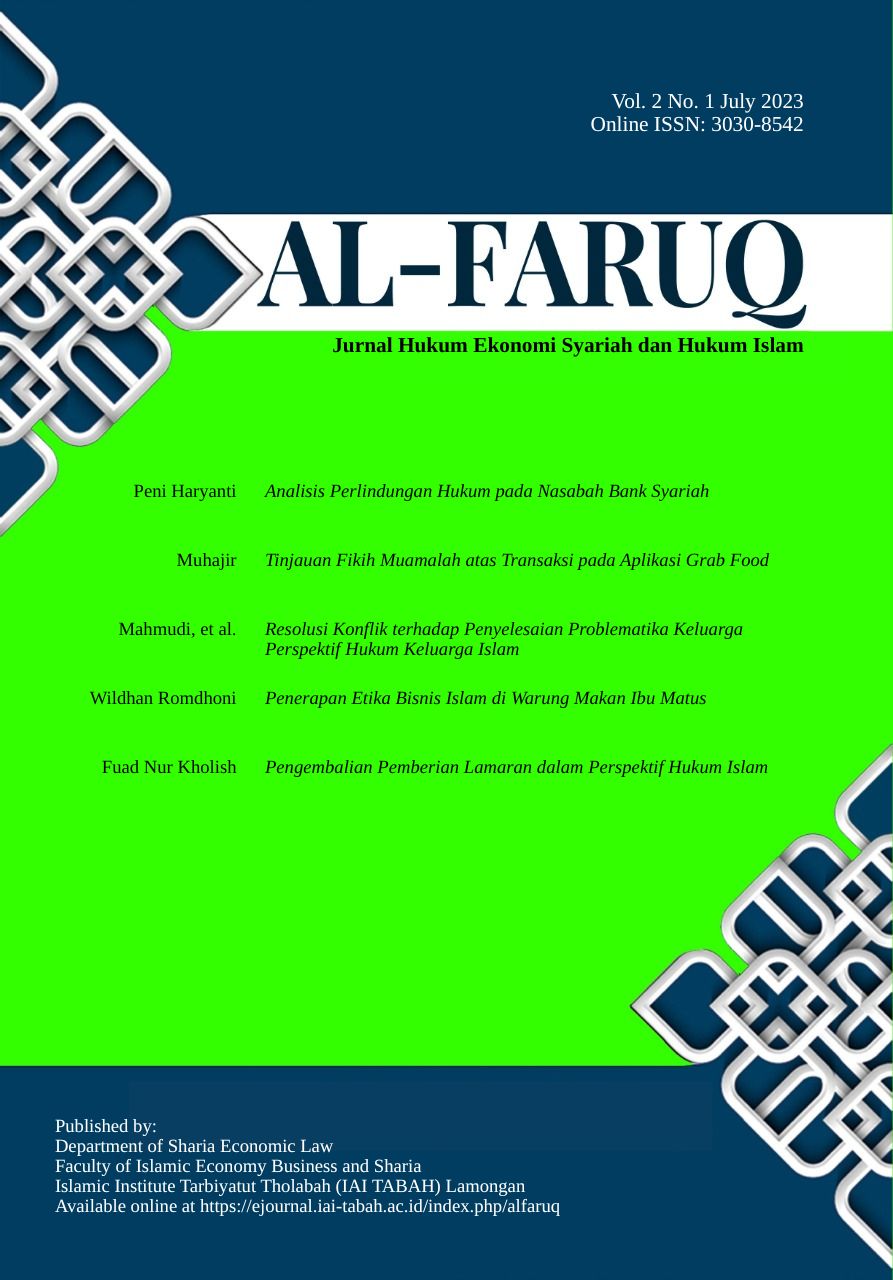
Penerapan Etika Bisnis Islam di Warung Makan Ibu Matus
Studi di Kelurahan Ujung Piring, Kecamatan Bangkalan, Kabupaten Bangkalan
DOI:
https://doi.org/10.58518/al-faruq.v2i1.2682Keywords:
Islamic business ethics, business code of ethics, food stallAbstract
Starting and running a business must be based on ethics, because the implementation of business ethics will lead to noble goals, both in the form of material and immaterial profits. In Islamic economics, the vision and mission of business activities are not only profit-oriented, but also prioritize the benefits of a product and the blessings in obtaining profits. In fact, in the midst of society, there are still shifts in doing business which are not in accordance with the commands of sharia. Therefore, this paper discusses the implementation of business in one of the food stalls in Ujung Piring Village, Bangkalan District, Bangkalan Regency, namely Warung Makan Ibu Matus. The study in this paper is a field research with data acquisition through observation and interviews as the primary data. Then the results of the data are analyzed descriptively which is associated with secondary data, namely the principles of business ethics contained in fiqh books, and other literature. The result of this article is that Warung Makan Ibu Matus has integrated all the principles of Islamic business ethics well, supported by positive responses from its consumers. This confirms that these principles are not only religiously relevant, but also have a positive impact in the context of business and relationships with consumers.
References
Aprianto, Iwan. Etika Dan Konsep Manajemen Bisnis Islam. Yogyakarta: Budi Utama, 2012.
Cahyono, Andi, Imam Mahdi, and Moch. Iqbal. “Analisis Penerapan Prinsip Etika Bisnis Islam Dalam Praktik Bisnis Isi Ulang Parfum.” Baabu Al-Ilmi 9, no. 1 (2024): 49–58.
Fogarty, Kieran, Roland Matthews, Joe Toussaint, Janet Zoro, Jackum Brown, and Sal Oliver. “Bankruptcy of Lehman Brothers.” Last modified 2008. Accessed May 25, 2023. https://www.britannica.com/event/bankruptcy-of-Lehman-Brothers.
Izzati, Sidqi Amalia. “Penerapan Etika Bisnis Islam Di Boombu Hot Resto Tegal,” 2015.
Lubaba, Abu, and Ari Kristin Prasetyoningrum. “Etika Bisnis Islam: Implementasi Pada UMKM Wirausahawan Krupuk Tayamum Di Desa Sarirejo Kecamatan Kaliwungu Kabupaten Kendal.” Jurnal Ekonomi dan Bisnis 22, no. 1 (2019): 27–36. https://jurnal.unikal.ac.id/index.php/jebi/article/view/751.
Silviyah, Nur Manna, and Novieati Dwi Lestari. “Pengaruh Etika Bisnis Islam Dalam Meningkatkan UMKM.” Al-Iqtishod: Jurnal Pemikiran dan Penelitian Ekonomi Islam 10, no. 1 (2022): 95–112.
Sugiyono. Metode Penelitian Kuantitatif, Kualitatif Dan R&D. Bandung: Alfabeta, 2016.
Usman, Mohammad, Wasik, and A Zainuddin. “Fitrah Manusia Dalam Pandangan Islam (Sebuah Kajian Konseptual Berbasis Al-Qur`an Dan Al-Hadits).” Ulumana : Jurnal Kajian Islam 8, no. 2 (2022): 284–298.
Wati, Destiya, Suyudi Arif, and Abrista Devi. “Analisis Penerapan Prinsip-Prinsip Etika Bisnis Islam Dalam Transaksi Jual Beli Online Di Humaira Shop.” El-Mal: Jurnal Kajian Ekonomi & Bisnis Islam 3, no. 1 (2021): 141–154.
Wulandari, Diniarti Novi, Budi Santoso, and Handry Sudhiarta Athar. “Etika Bisnis E-Commerce Berdasarkan Maqashid Syariah Pada Marketplace Bukalapak.Com.” JMM Unram : Jurnal Magister Manajemen Universitas Mataram 2, no. 3 (2022): 1–13.
Downloads
Published
Issue
Section
License
Copyright (c) 2023 Al-Faruq: Jurnal Hukum Ekonomi Syariah dan Hukum Islam

This work is licensed under a Creative Commons Attribution-ShareAlike 4.0 International License.
Authors who publish with this journal agree to the following terms:
- Copyright on any article is retained by the author(s).
- The author grants the journal, right of first publication with the work simultaneously licensed under a Creative Commons Attribution License that allows others to share the work with an acknowledgment of the work’s authorship and initial publication in this journal.
- Authors are able to enter into separate, additional contractual arrangements for the non-exclusive distribution of the journal’s published version of the work (e.g., post it to an institutional repository or publish it in a book), with an acknowledgment of its initial publication in this journal.
- Authors are permitted and encouraged to post their work online (e.g., in institutional repositories or on their website) prior to and during the submission process, as it can lead to productive exchanges, as well as earlier and greater citation of published work.
- The article and any associated published material is distributed under the Creative Commons Attribution-ShareAlike 4.0 International License